Activity at Hospital Flat Illustration: Evaluating This Healthcare Illustration Set
When you need visual content for a medical or healthcare project, the right illustrations can save hours of design time and convey complex messages clearly. The Activity at Hospital Flat Illustration pack offers six ready-made flat-style scenes showing everyday activities in a hospital setting. But before you add it to your asset library, it’s worth evaluating what this product delivers, where it shines, and where alternatives might serve you better.
What You Actually Get in the Activity at Hospital Flat Illustration Pack
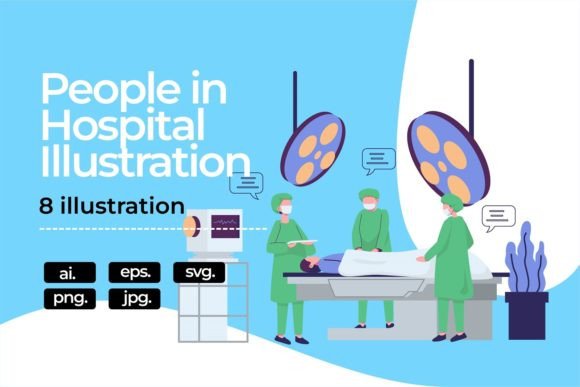
At its core, this is a collection of six digital illustrations focused on typical hospital flat environments—think waiting areas, patient rooms, nurse stations, or corridors with staff and patients interacting. The visuals use a clean flat design approach with solid colors, minimal shading, and simplified human figures. The package includes multiple file formats: EPS, AI, SVG, PNG, and JPG. That variety means you can open and edit the vector files in Adobe Illustrator or other compatible software, or use the high-resolution PNG and JPG versions directly in presentations, websites, or print layouts. The pack comes in RGB color mode by default, but because the vector formats are fully editable, you can shift the artwork to CMYK for professional printing if needed.
Who Typically Seeks Out This Kind of Illustration
Understanding the typical user helps you see if you’re in the same boat. People searching for Activity at Hospital Flat Illustration are often:
- Web designers building a hospital or clinic website and needing hero images or section dividers that feel warm and approachable.
- Presentation creators preparing slide decks for healthcare conferences, internal training, or patient education sessions.
- Infographic designers who want to depict hospital workflows, patient journeys, or service statistics without relying on generic stock photography.
- Content marketers in the medical field creating blog posts, newsletters, or social media graphics where an illustrated style fits the brand.
In each case, the need is similar: a visually consistent, editable set of scenes that communicate activity without the cliché of smiling doctors in white coats holding clipboards.
Key Advantages Worth Considering
Several practical benefits make this pack a candidate for your next project.
- Vector flexibility and editability. The included EPS, AI, and SVG formats mean you can scale any illustration to billboard size without losing quality, and you can tweak every element—color palettes, character poses, even background details—to match your brand.
- Color mode control. Starting in RGB works well for digital screens, but you can open the editable vector files and convert them to CMYK. This avoids the headache of grainy color shifts when a print shop requires CMYK-compatible artwork.
- Time efficiency. Instead of commissioning six custom hospital flat illustrations from scratch, you get a ready-to-go set. For tight deadlines, that alone can be a major advantage.
- Flat style versatility. Flat illustration remains a popular choice for modern interfaces because it’s clean, loads quickly on websites, and doesn’t distract from text. When your content needs to feel professional yet friendly, flat art often strikes the right balance.
- Multiple output formats. The PNG and JPG options give you quick access for immediate use, while the vector source files keep long-term editing doors open.
Tradeoffs and Practical Limitations
No asset pack fits every scenario perfectly. Here’s where the Activity at Hospital Flat Illustration might fall short for some users.
- Limited scene count. With only six scenes, you may run out of variety quickly if you’re creating a large website or a multi-page brochure. You might need to supplement the pack with additional illustrations from other sources, and maintaining visual consistency could become a challenge.
- Flat style isn’t for everyone. Some healthcare brands lean toward photographic realism to build trust, or they use highly detailed iconography to emphasize precision. A flat, simplified look could feel too casual for a serious surgical practice or an academic medical journal.
- Customization effort. While the files are editable, significant changes—like repositioning limbs, altering facial expressions, or completely redesigning a room layout—require solid vector editing skills. If you lack that expertise, you may be limited to basic color swaps.
- Licensing and usage scope. Always review the specific license attached to the pack. While many illustration packs allow commercial use, restrictions can vary. Verify that you can use the images in templates, merchandise, or other intended applications without extra fees.
- Not a complete illustration system. If your project demands a library of 50 or 100 cohesive characters and environments, this six-illustration set will only serve as a starting point.
Situations Where the Pack Is a Strong Fit
Certain project profiles align nearly perfectly with what the pack offers. You’ll likely find strong value if:
- You’re designing a small-to-medium clinic website and need a friendly “About Us” section, a blog header, and a few service page visuals that share the same illustration family.
- You’re building an infographic that explains a hospital’s patient intake process in three to five steps, and the provided scenes closely match your story.
- You’re preparing a slide deck for a healthcare startup pitch and want to replace bullet points with visual metaphors of hospital activity—the pack gives you just enough variety without overwhelming the audience.
- You plan to recolour the illustrations to match a strict brand palette. Because the files are editable, a one-time color adjustment makes the entire set consistent with your style guide.
In these cases, the modest scene count actually works in your favor: less clutter, faster decisions.
When It Makes Sense to Look at Alternatives
No single resource fits every creative brief. Consider alternatives when:
- Realism is essential. If you’re designing for a medical device company that demands high-fidelity photos of specific equipment in use, flat illustrations can’t replicate that documentary feel. Stock photography or 3D renders might work better.
- You need extensive scene variety. For a large hospital system website with departments ranging from pediatrics to oncology to administration, six generic hospital flat illustrations will quickly become repetitive. A subscription to a larger illustration library or a custom illustration project would be more practical.
- Interactivity or animation is required. Static illustrations won’t support explainer videos, Lottie animations, or interactive user interface elements. You’d need source files structured for motion graphics, which this pack may not provide.
- Your brand already uses an established illustration style. If your design system relies on hand-drawn line art or isometric views, a flat pack will clash. Maintaining consistency often trumps convenience.
- You lack any vector editing software. While PNG and JPG files are usable, you’d miss out on the pack’s biggest strengths—scalability and full color control—if you can’t open AI or EPS files.
Practical Decision-Making: Does Activity at Hospital Flat Illustration Align with Your Goals?
Instead of asking “Is this a good product?” ask “Does it solve my immediate problem without creating new ones?” Here’s a straightforward checklist to run through.
- Match your visual identity. Does your brand or project style lean modern, clean, and approachable? Flat illustrations typically support that direction. If your brand is more traditional or clinical, test a sample image against your existing assets before committing.
- Assess scene relevance. Look at the six included illustrations—they likely depict common hospital flat activities. Check whether at least four of them can be directly used or easily adapted. If you’re forcing a scene into a context it wasn’t made for, usability drops sharply.
- Evaluate your editing comfort level. If you regularly work with Adobe Illustrator or Affinity Designer, color changes and layout tweaks will be straightforward. If not, the pack’s true value may remain locked behind a skill barrier.
- Consider your output channels. Are you creating primarily for web and presentations? RGB is fine. Need print collateral like brochures or posters? You’ll need to convert to CMYK. The pack allows that, but factor in the time to adjust colors for print accuracy.
- Weigh cost against custom alternatives. A pack of six editable illustrations is typically far less expensive than hiring an illustrator for even one custom scene. However, if the pack only partly fits your needs and requires substantial rework, the total effort might approach that of a tailored solution.
- Think about long-term use. Will you reuse the illustrations across multiple future projects, or is this a one-off need? If you often create healthcare content, the pack could become a reusable building block. If this is a single campaign, borrowing elements from a broader subscription service might make more sense.
The Bottom Line on Activity at Hospital Flat Illustration
The Activity at Hospital Flat Illustration product delivers a focused, editable collection of hospital-themed flat scenes in versatile file formats. It addresses a frequent pain point for designers who need healthcare visuals that are easy to modify and deploy quickly. The SVG, AI, EPS, PNG, and JPG mix supports everything from web headers to printed flyers, and the RGB-to-CMYK flexibility adds a layer of professional adaptability.
That said, its value hinges entirely on your specific context. If you only need a handful of consistent, flat-style hospital scenes and have the software to tweak them, this pack can be a smart, time-saving purchase. If your project demands realism, massive variety, or motion-ready assets, you’ll likely need to supplement or skip it entirely. Use the decision points above to judge whether this illustration set moves your project forward or simply adds another folder to your hard drive. The goal isn’t to find the perfect asset for everyone—it’s to find the right asset for the work in front of you.